


What is an E-Commerce Management Software?
E-Commerce Software allows businesses to sell products or services online. Users can add, edit, and organise products, set prices, manage inventory levels, and upload images and descriptions. Allows customers to select products they wish to buy, review them, and hold them until they are ready to complete the purchase. Users can track the order, update its status (e.g., Processing, Shipped, Delivered), and manage returns or refunds. Allow customers to see how a product (like a couch or a pair of sneakers) looks in different colours or configurations in real-time. In addition, users can collect more customer data over time through successive interactions instead of asking for everything at once.
E-Commerce Software enables users to sync inventory across all sales channels and integrate with shipping carriers (such as USPS and FedEx) to calculate rates and print labels. It offers built-in features like SSL certificates to encrypt data and compliance with standards like PCI DSS to keep payment information safe. Allows users to create coupon codes (percentage, fixed amount, free shipping).
Features of E-Commerce Management Software
- Users can integrate with Amazon and eBay, as well as social media platforms like Instagram and Facebook.
- Users can connect with services like Mailchimp, Klaviyo, or Omnisend to run abandoned cart emails and newsletters.
- It enables users to set up a "subscribe and save" model for products that customers buy regularly.
- Allows users to connect with payment gateways (like Stripe, PayPal, or Square) to process credit card and digital wallet payments.
- Allows B2B customers to request a formal quote, which a sales rep can then approve and convert into an order.
- Users can see where customers drop off in the buying process, from product view to checkout completion.
List of E-Commerce Management Software
When you start looking for the best e-commerce software, it is easy to get overwhelmed with the list of options available. Here is the handpicked list of e-commerce software to choose as per your requirement:
1. Shopify Plus

Shopify Plus is an e-commerce software suitable for large ventures, wholesalers, and enterprise-level e-commerce shops, allowing customisation, high-demand sales, and scalability. It enables you to manage products, content, and pricing without code, including conversion-tested themes for personalised design layouts and functionality. Allows users to sell in multiple regions in different languages.
Shopify Plus e-commerce software allows users to have complete control over the entire checkout process and access over 100 payment gateways. Its advanced reporting and analytics features, boosted by Google’s enhanced e-commerce analytics engine, help online retailers get deep insights and understand customers better.
Key Features:
- Provides an open API that allows businesses to integrate their existing ERP or CRM to sync inventory, customers, and orders
- Enables users to customise navigation and user experiences across all types of devices and screen sizes
- Users can automate e-commerce campaigns and flash sales using Launchpad to schedule products and promotions for publishing across multiple channels
- Also allows you to operate up to 11 different storefronts from one Shopify Plus account
To know more about Shopify Plus E-Commerce Software features and product options, click here to continue.
2. BigCommerce
BigCommerce is an e-commerce software that empowers your team to manage a website consisting of large catalogues. Allows users to automate customer and pricing segmentation, purchase orders, payment terms, user roles, and integrations with major ERP, OMS, and CRM systems. Provides native CSR-generated quote management, and bulk pricing is broken down to the SKU level for each customer and customer group. BigCommerce e-commerce software also enables users to access shopping lists created by customers and generate a custom quote.
Key Features:
- Allows users to provide additional discounts to customers on top of pre-arranged pricing
- Enables users to add, edit, show, or hide approved payment options for customers
- Users can manage the corporate account and set up multiple tiers of buyers who have specific roles and permissions
- Also allows buyers to manage and save multiple shopping lists
To know more about BigCommerce E-Commerce Software features and product options, click here to continue.
3. Wix

Wix is an e-commerce software that allows individuals and businesses to create an online store without coding. Users can visually design every part of your store—homepage, product pages, cart—with immense creative freedom. Users can sell physical, digital, and service-based products and manage variants (size, colour, etc.), inventory, and SKUs. Users can track stock levels automatically as sales are made, get low-stock alerts, and manage inventory across multiple variants. In addition, it can automatically send email reminders to customers who added items to their cart but didn't complete the purchase.
Wix e-commerce software enables users to create point-based or tiered loyalty programs to reward repeat customers and encourage brand loyalty. It offers customers local pickup (in-store or curbside) or local delivery options with specific time slots. Users can get detailed insights into your store's performance with reports on sales, traffic, product performance, and customer behaviour to make data-driven decisions.
Key Features:
- Allows users to accept credit or debit cards without third-party transaction fees
- It offers strong SEO features to help your store rank in search engines
- Users can integrate with social media and marketplaces (e.g., Facebook, Instagram, Amazon)
- Allow customers to create accounts for faster checkout, order history tracking, and saved wishlists
To know more about Wix E-Commerce Software features and product options, click here to continue.
4. Squarespace

Squarespace is an e-commerce software that enables users to manage their website and online store. Users can create options like size, colour, material, etc., with individual SKUs, prices, and images for each combination. Allows users to sell Physical Products, Digital Downloads, Services, and Subscriptions. It can track stock levels automatically, get low-stock alerts, and manage inventory across multiple locations. In addition, users can tag products from their Instagram posts and stories, linking directly to your Squarespace checkout.
Squarespace e-commerce software allows users to get detailed insights into their sales, revenue, and traffic with visual reports to see which products are performing best and understand customer behaviour. Allows customers to join a waitlist for out-of-stock items and get notified when they're back. Users can add an option for customers to leave a tip during checkout, ideal for service-based businesses or creators.
Key Features:
- It supports multiple high-resolution images, and some templates allow for interactive image zoom
- Allow customers to create accounts to track orders, save addresses, and check out faster in the future
- Customers can see key product details and add to cart from a pop-up without leaving the page they're on
- It can automatically send email reminders to customers who left items in their cart
To know more about Squarespace E-Commerce Software features and product options, click here to continue.
5. Oracle CX
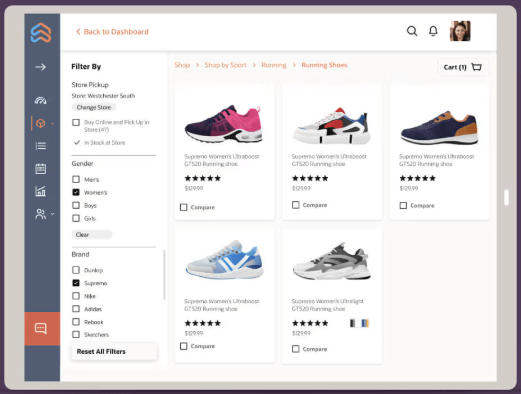
Oracle CX is an e-commerce platform that helps B2C and B2B companies create unified, personalised, and scalable digital shopping experiences. Users can group customers based on explicit data (profile and company) and implicit behaviour (browsing history and past purchases) to deliver personalised content and offers. Promotions can be triggered based on customer segment, geolocation, order value, or product attributes. Allows sales reps or customers themselves to generate quotes from a cart, which can then be negotiated and converted into an order. In addition, users can connect with other Oracle Cloud applications (like Eloqua for marketing, Service Cloud for customer service) and third-party systems (ERPs, PIMs, OMS) via pre-built connectors.
Key Features:
- It offers a powerful search with merchandising rules to ensure the most relevant products appear first
- Allows business users to create and launch new landing pages, category pages, and promotional content
- It offers a behavioural analytics engine that tracks and analyses every customer interaction
- Allows users to manage recurring payment models and automated product replenishment programs
To know more about Oracle CX E-Commerce Software features and product options, click here to continue.
6. Podia
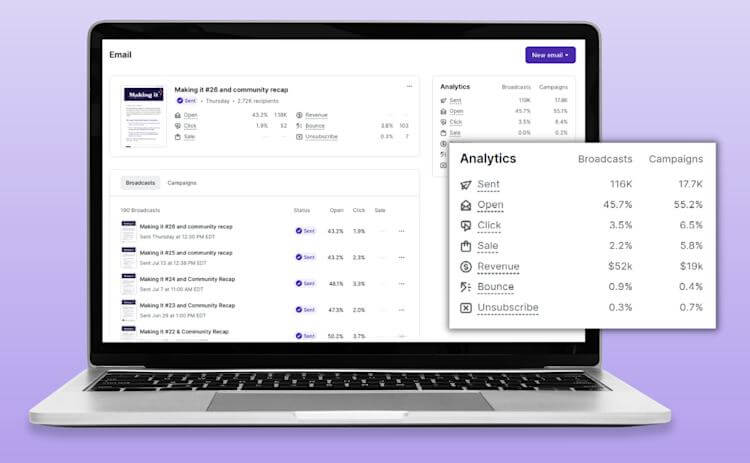
Podia is an e-commerce software that allows businesses to sell e-books, PDFs, cheat sheets, presets, software, or digital files. Users can add their Facebook Pixel and Google Analytics tracking codes to their entire site to track conversions, retarget visitors, and gather valuable data on their audience. Digital products are delivered automatically and instantly upon successful payment. The files are stored securely and can't be shared via a public link. In addition, users can unlock lessons or membership content on a schedule (e.g., daily, weekly, or on a specific date). This is crucial for maintaining student engagement and preventing overwhelm.
Key Features:
- It automatically retries failed subscription payments and emails the customer, helping users recover lost revenue from expired cards
- It has a built-in payment processor. Users don't need a separate Stripe or PayPal account (though they can connect them if they prefer)
- Users can create a subscription-based community or content hub where members pay monthly or yearly for access
- Allows users to set up an affiliate program so others can promote their products for a commission
To know more about Podia E-Commerce Software features and product options, click here to continue.
7. Zoho Commerce
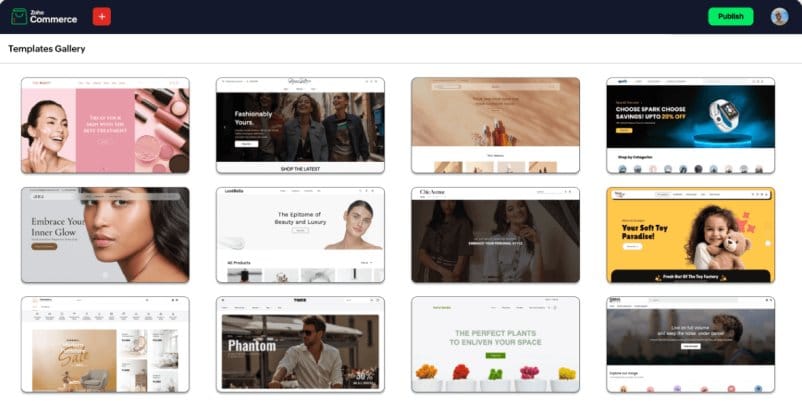
Zoho Commerce is an e-commerce software designed to help businesses create and manage their online stores. Users can add and manage physical, digital, and service-based products. Allows users to define multiple options like size, colour, and material for a single product. It can automatically update stock levels and set up low-stock alerts to prevent overselling. Users can use CSV files to quickly upload or update large numbers of products. In addition, users can update order status (Processing, Shipped, Delivered) to notify customers.
Zoho e-commerce software can automatically send emails to customers who left items in their cart to encourage them to complete the purchase. Allows users to list and sell products directly on Facebook, Instagram, and Pinterest from their Zoho Commerce dashboard. Users can sync customer data and order history for superior sales follow-up and relationship management.
Key Features:
- It offers built-in integrations with major carriers like USPS, FedEx, and UPS for calculating live shipping rates and printing labels directly from the dashboard
- Users can create flexible discount rules (percentage, fixed amount, free shipping) for specific products, categories, or customer groups
- It supports Zoho Payments, Stripe, PayPal, Square, Authorize.net, and many regional providers
- Users can customise page URLs, meta titles, descriptions, and alt tags to improve search engine rankings
To know more about Zoho Commerce E-Commerce Software features and product options, click here to continue.
8. Odoo
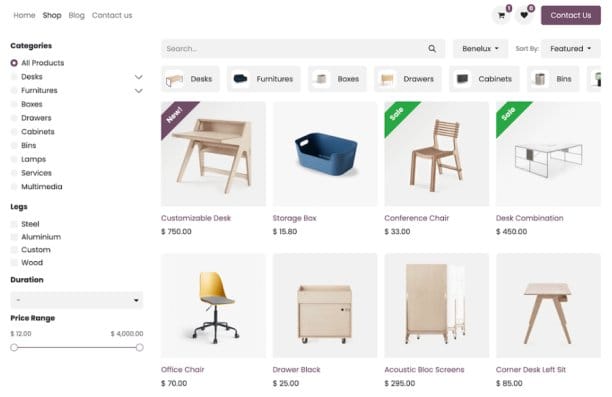
Odoo is an e-commerce software that allows users to manage products with multiple attributes, such as size, colour, and material. Users can sell and deliver downloadable products like e-books, software, or digital courses. Allows users to create complex pricing rules for different customer segments (e.g., wholesale vs. retail), specific countries, or based on order quantity. In addition, users can connect with carriers like UPS, FedEx, DHL, and USPS to display accurate shipping costs to customers based on their location and cart weight.
Key Features:
- Users can create options for guest checkout or mandatory account creation to streamline the buying process for returning customers
- Users can edit critical on-page SEO elements like page titles, meta descriptions, URL slugs, and alt-text for images
- It can automatically send reminder emails to customers who added products to their cart but didn't complete the purchase
- Allows users to integrate with PayPal, Stripe, Authorize.Net, Adyen, and many regional providers
To know more about Odoo E-Commerce Software features and product options, click here to continue.
9. Webnode

Webnode is a cloud-based e-commerce software that allows individuals and small businesses to create a professional online presence. Users can sell physical goods, digital products (like e-books, software, music), and services. Users can define attributes like size, colour, or material for a single product and automatically track stock levels and get low-stock alerts. Allows users to sort products into categories and subcategories for better store navigation and save time by adding or updating many products at once using a CSV file.
In addition, Webnode e-commerce software enables users to set up various shipping methods with fixed prices or rates based on order price, weight, or the number of items. Allows users to connect their store to Google Analytics for in-depth traffic and customer behaviour analysis.
Key Features:
- Allow customers to create accounts for faster checkout and order history tracking
- Users can create and manage discount codes for percentages or fixed amounts off the cart
- It can send automatic order confirmation and status update emails to keep customers informed
- Users can accept payments via PayPal, Stripe, Google Pay, and Apple Pay
To know more about Webnode E-Commerce Software features and product options, click here to continue.
10. Pixpa

Pixpa is an e-commerce software that allows users to sell physical products (like prints, books, merchandise), digital products (like presets, templates, e-books), and services from their websites. It offers automated delivery of digital files. Customers get a secure download link immediately after purchase. It can track stock levels for your physical products. The system can alert users when inventory is running low, helping them avoid overselling. In addition, it can automatically send an email to customers who added items to their cart but didn't complete the purchase, encouraging them to return and check out.
Pixpa allows customers to join a waitlist for products that are currently out of stock. This helps users capture demand and gauge interest before restocking, and can automatically notify customers when the item is back. Every Pixpa site comes with a free, auto-renewing SSL certificate. This encrypts data and ensures that all transactions and data transfers on the site are secure, which is also a positive ranking factor for Google.
Key Features:
- Users can customise page titles, meta descriptions, and URLs to help their site rank in search engines
- Users can integrate with Stripe, PayPal, and Razorpay to accept credit/debit cards and other local payment methods
- Allows users to run promotions easily by creating percentage or fixed-amount discounts
- Users can set up automatic tax rules for different countries, states, and regions
To know more about Pixpa E-Commerce Software features and product options, click here to continue.
Conclusion
E-Commerce Software has evolved far beyond a simple digital checkout. It has become the central nervous system for any business that sells online, integrating every function from the first customer impression to the final fulfilment and beyond. Users can route orders to the closest warehouse or fulfilment centre to the customer to reduce shipping time and cost. It can automatically populate categories based on rules like "bestselling products," "tags," or "inventory level."
Featured Image Courtesy – Photo by Shutter Speed on Unsplash
